
This methods paper describes the trial that will answer that question; it does not yet report clinical outcomes. More than 32,000 eligible encounters are planned across five systems.
The research question
Does placing an AI-ECG low-ejection-fraction alert inside routine EHR workflow change clinical evaluation and detection across different health systems?
Overview
The cluster-randomized AIM ECG-AI study moves beyond model accuracy to test how clinicians use an EHR-integrated low-ejection-fraction signal during routine outpatient care. AIM ECG-AI is an implementation study, not an effectiveness result. It is designed to learn whether an FDA-cleared low-LVEF signal changes clinician behavior and detection when delivered through real outpatient EHR workflows. High model performance does not guarantee clinical benefit. Implementation research must measure whether clinicians see, trust and act on an AI result—and whether that changes downstream evaluation.
Study design & methods
Clinicians and care teams are assigned to receive the ECG Viewer and actionable best-practice alerts or to continue usual care. Randomization at the care-team level reduces contamination between colleagues. Intervention clinicians receive a best-practice alert when an eligible encounter has an actionable result. Control clinicians do not receive the alert or access the intervention software. Care teams at five U.S. health systems are cluster-randomized to receive an AI-ECG viewer and actionable best-practice alerts or to continue usual care. Eligible adults have a digital twelve-lead ECG without known heart failure or low LVEF.
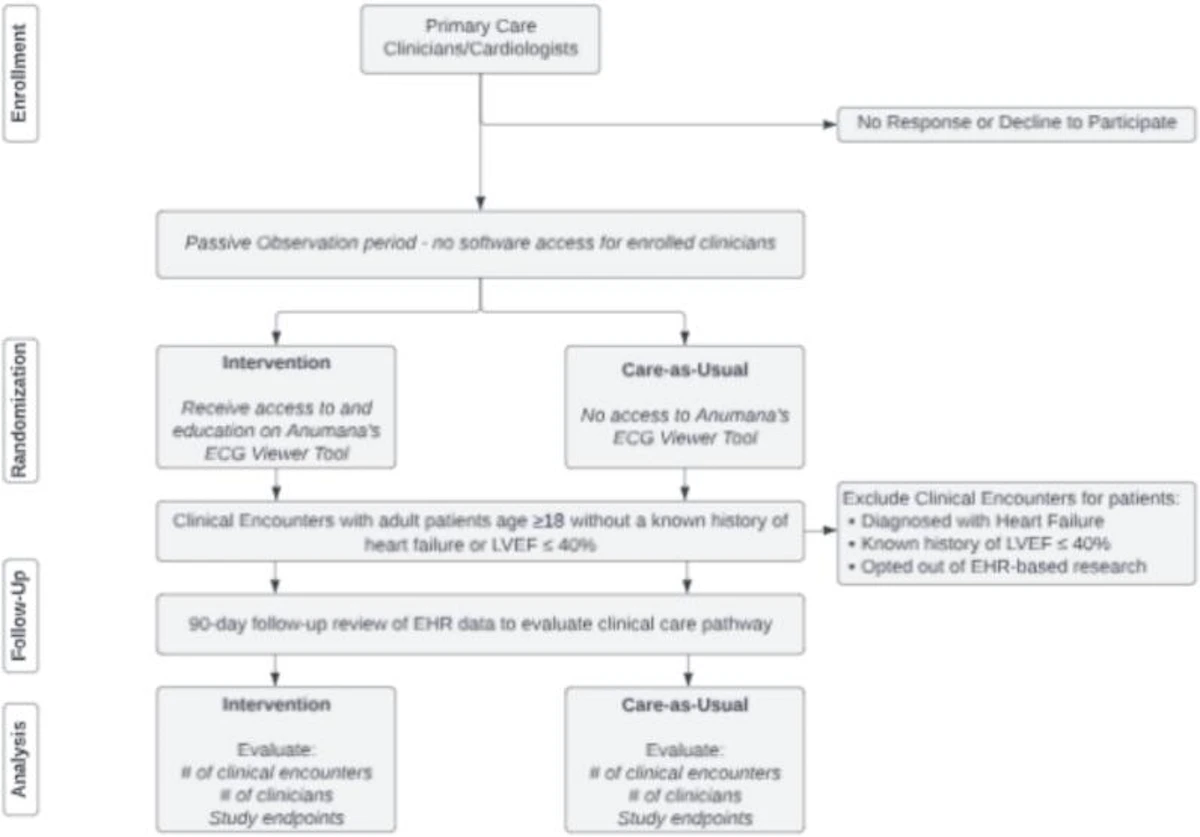
Clinical actions and low-LVEF detection are the outcomes
The study will use clinician surveys, software-use metrics and EHR data to measure decision-making. The central clinical endpoint is detection of LVEF at or below 40% by echocardiography. The protocol includes exploratory endpoints and subgroup analyses, but no effectiveness result is available in this paper. The trial is registered as NCT05867407. This paper reports the prespecified trial structure, implementation endpoints and analytic plan. It does not report whether the intervention improved evaluation, low-LVEF detection or patient outcomes.
Limitations & interpretation
The study is important because real-world integration introduces workflow, alert-fatigue, access and follow-up questions that retrospective validation cannot answer. The study is sponsored by Anumana. Its major contribution is a reproducible implementation design for testing whether an AI signal changes care across diverse clinical environments. The trial addresses the gap between retrospective model accuracy and clinical benefit. Cluster randomization and multi-system deployment make workflow effects, alert fatigue and follow-up behavior part of the evaluation. Design and methods paper; no clinical effectiveness result yet.
Publication type and venue follow the original nference listing. Read the original paper for full methods, analyses, and interpretation. View source listing.