
Higher attained dose was strongly associated with lower later cardiovascular risk, while achieved weight loss was not significantly associated with mortality or the composite cardiovascular endpoint.
The research question
Is semaglutide’s later cardiovascular benefit more closely associated with the dose patients reach or the amount of weight they lose?
Overview
In patients with existing cardiovascular disease, higher attained semaglutide dose was associated with lower later cardiovascular risk even when achieved weight loss was not. The landmark design separates the first two years, when dose and weight change were measured, from the later period when cardiovascular outcomes were counted. The central result is a divergence: attained dose tracked with later cardiovascular risk, while achieved weight loss tracked with metabolic measures but not the principal cardiovascular endpoints. The distinction matters because cardiovascular benefit may reflect therapeutic exposure and direct biology rather than simply being a downstream consequence of weight loss.
Study design & methods
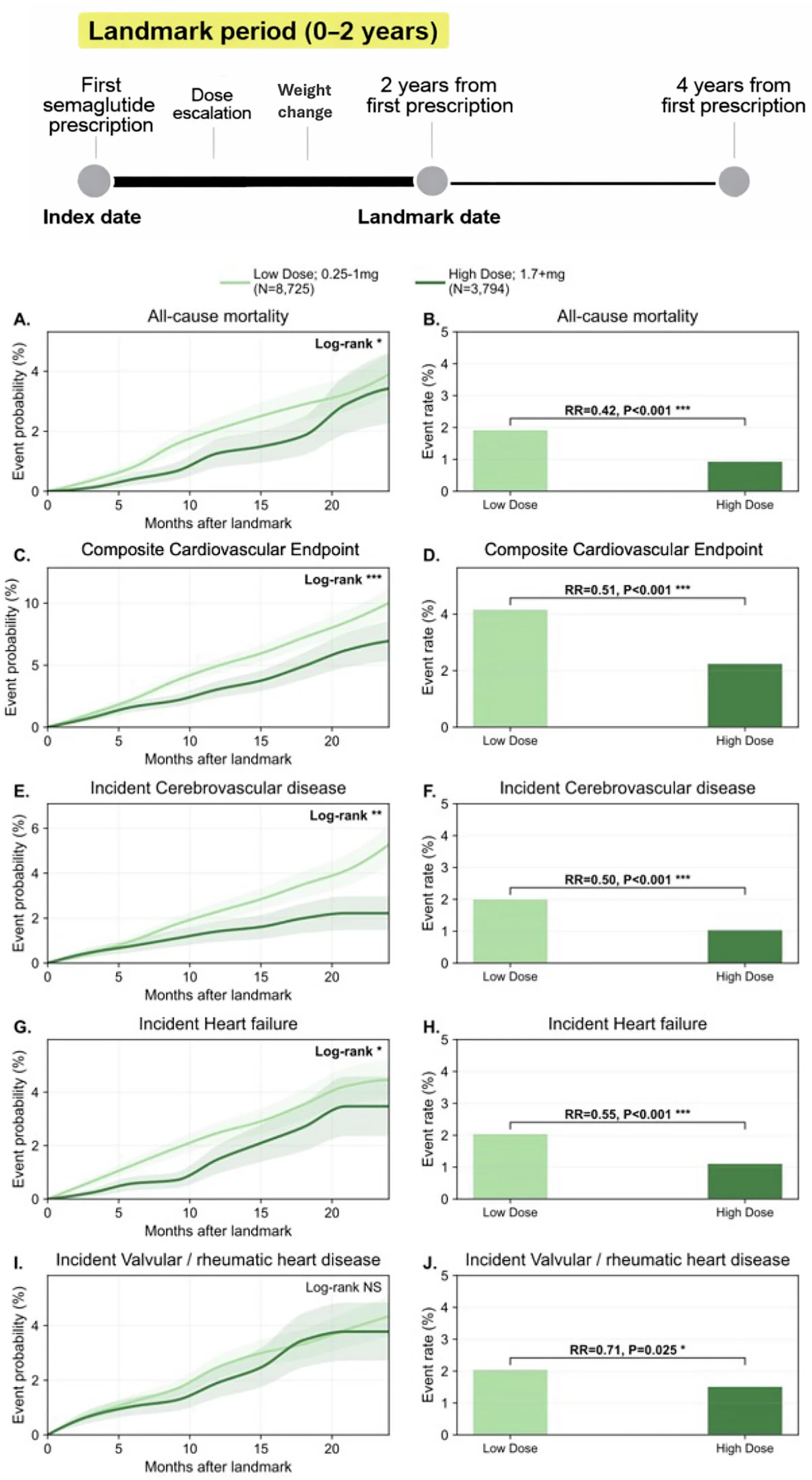
The researchers identified 47,199 semaglutide initiators in a federated de-identified EHR network. A landmark cohort of 12,519 patients had at least two years of follow-up in which dose escalation and weight loss could be measured. Dose and weight were measured during years zero through two; outcomes were assessed afterward through the January 2026 data cutoff to reduce reverse timing between exposure and outcome. Patients initiating semaglutide between March 2018 and January 2024 were identified in the nSights Federated EHR Network after a one-year washout. Baseline cardiovascular disease required repeated diagnosis dates, and baseline weight was taken from a defined window around initiation.
Dose and later cardiovascular risk moved together
Each 1 mg increase in maximum attained dose was associated with 3.15% additional weight loss. Higher versus lower dose was associated with relative risks of 0.42 for mortality, 0.51 for the composite cardiovascular endpoint, 0.50 for cerebrovascular disease and 0.55 for heart failure. The matched comparator analyses also found lower cardiovascular event rates with semaglutide than with three other glucose-lowering treatment groups across baseline cardiovascular-burden strata. The landmark cohort contained 8,725 people in the lower-dose group and 3,794 in the higher-dose group. Higher attained dose was associated with lower post-landmark risk across mortality, the death–MI–stroke composite, cerebrovascular disease and heart failure after correction for multiple comparisons.
Limitations & interpretation
The findings suggest that cardiovascular benefit may align more closely with therapeutic exposure than with weight loss itself. High GLP1R expression in cardiomyocytes and cardiac endothelial cells offers a biological hypothesis for further study. The transcriptomic component was explicitly hypothesis-generating and did not demonstrate a validated pharmacokinetic or pharmacodynamic relationship in the heart. The authors propose that therapeutic exposure may engage cardiovascular biology beyond the amount of weight a patient loses. Cardiac GLP1R patterns provide a mechanistic direction, but not proof of dose-dependent target engagement. Dose attainment was not randomized.
Publication type and venue follow the original nference listing. Read the original paper for full methods, analyses, and interpretation. View source listing.