
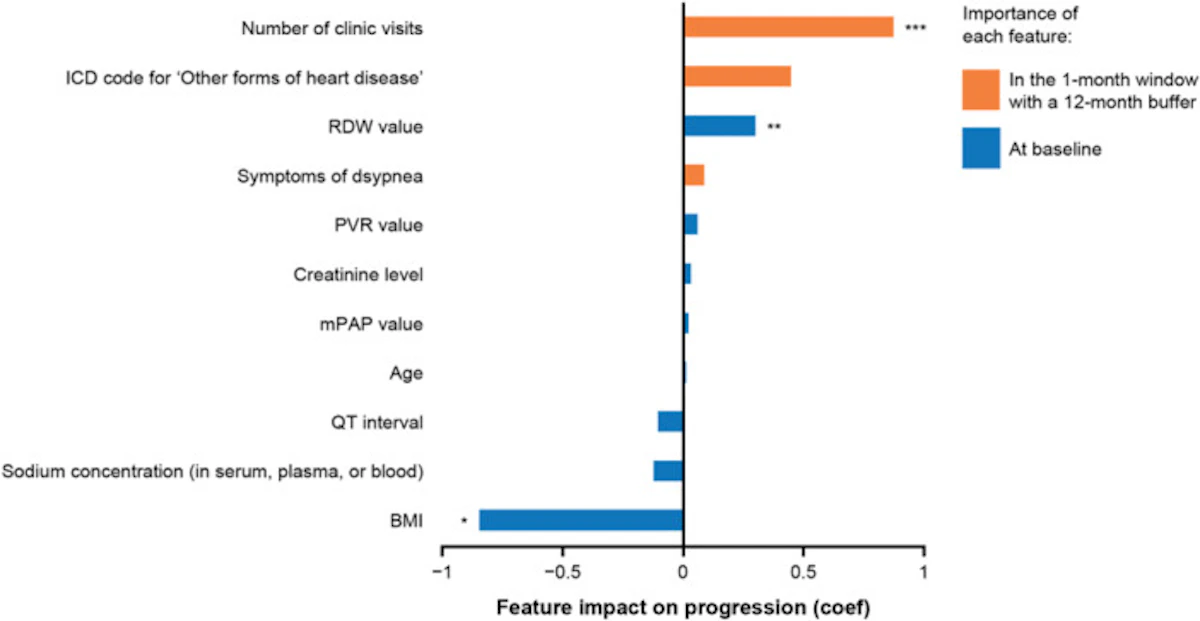
The best exploratory model reached an AUC of 0.78 and retained eleven clinical features. Recent clinic visits, baseline red-cell distribution width and baseline BMI were the most consistent signals.
The research question
Can routinely collected EHR signals identify patients with pulmonary arterial hypertension who are approaching a clinical worsening event?
Overview
A moving-window model linked clinical measurements and recent care patterns to near-term worsening, reaching an AUC of 0.78 in 455 patients with likely pulmonary arterial hypertension. This exploratory model asks whether time-varying EHR signals can flag a patient with PAH before a clinical worsening event. The strongest model combined recent utilization with laboratory and baseline clinical features, but it remains a research result awaiting external validation. PAH risk changes between scheduled assessments. A dynamic EHR signal could eventually complement formal risk scores by surfacing short-term changes that warrant review.
Study design & methods
The cohort included adults with right-heart-catheterization-confirmed disease at Mayo Clinic between 2015 and 2019. The likely-PAH definition also required precapillary hemodynamics and recorded PAH treatment. The model considered 100 baseline and time-updated features. Worsening windows covered the period immediately before an event; progression-free windows were constrained by six- or twelve-month post-event buffers. The single-center cohort included 455 adults with likely PAH and right-heart-catheterization evidence. One hundred baseline and time-updated features were evaluated in moving observation windows before clinical worsening or progression-free periods.
Recent care activity carried a strong near-term signal
The best model used a one-month observation window with a twelve-month buffer. It reached AUC 0.778, sensitivity 77.9%, specificity 58.5%, positive predictive value 72.1% and negative predictive value 65.8%. Of 455 likely-PAH patients, 232 experienced a worsening event after a median 10.9 months. A proposed score placed 82% of the high-risk stratum among progressors, while 74% of the low-risk stratum remained progression-free. The best one-month-window model reached AUC 0.778, sensitivity 77.9% and specificity 58.5%. It retained eleven features, including recent clinic visits, other-heart-disease codes, red-cell distribution width and body-mass index.
Limitations & interpretation
The work shows that dynamic utilization and laboratory signals may add context that static assessments miss. The authors position the approach as a potential complement to established PAH risk tools rather than a replacement. Higher RDW, lower BMI and more recent clinic visits emerged most consistently, but BMI and QT relationships were complex. Independent calibration, clinical-utility testing and outcome evaluation are required before deployment. The result suggests ordinary EHR activity may complement formal PAH risk assessment between scheduled visits. Moderate specificity means an alert would need careful thresholding and workflow testing. Single-health-system retrospective cohort.
Publication type and venue follow the original nference listing. Read the original paper for full methods, analyses, and interpretation. View source listing.