
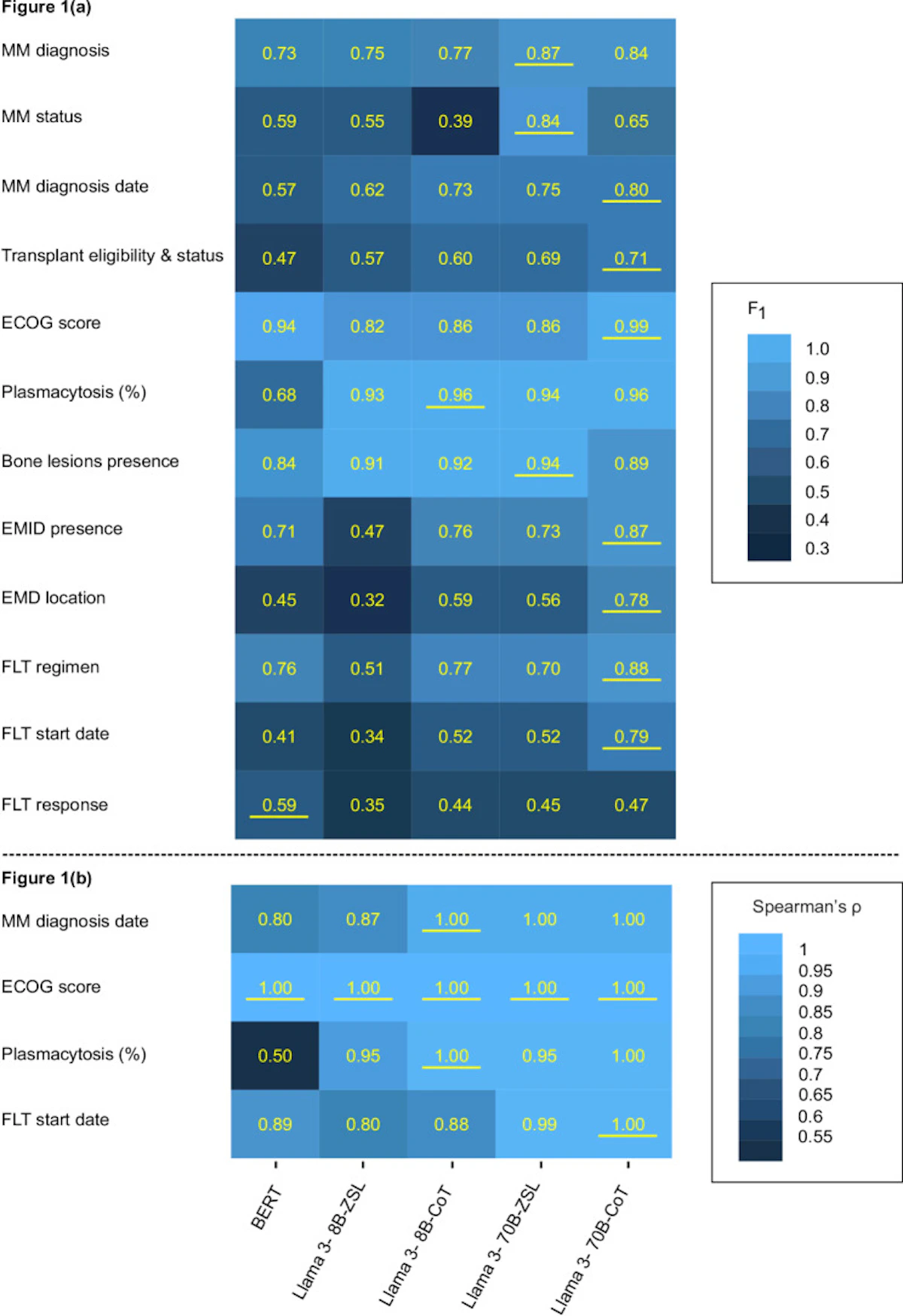
The best Llama workflow averaged F1 0.82 across twelve fields, compared with 0.65 for the best BERT workflow, with field-level performance ranging from 0.59 to 0.99.
The research question
How reliably can large language models turn multiple-myeloma notes into structured research variables?
Overview
The study tested how model size, prompt design, variable type and human agreement shape the reliability of clinical-note abstraction. The paper treats LLM extraction as a field-by-field engineering decision. Averages favored Llama, but the wide performance range showed that model size, prompt design and the inherent ambiguity of the target variable all matter. Manual oncology abstraction is expensive. Knowing which variables and prompt strategies benefit most from LLMs can direct human review toward the hardest fields.
Study design & methods
Researchers developed BERT- and Llama-based workflows for twelve multiple-myeloma variables and compared them with manual labels from 125 clinical notes. Human inter-rater reliability was used as an estimate of inherent abstraction difficulty and then tested as a predictor of model performance. Twelve multiple-myeloma data fields were selected to span numeric, categorical and longitudinal abstractions. Manual labels from 125 notes formed the evaluation set for BERT rules and several Llama prompting approaches.
Larger models helped most on harder abstraction tasks
Average F1 was 0.82 for the best Llama workflow and 0.65 for the best BERT workflow. Performance by variable ranged from 0.59 to 0.99. The 200-patient demonstration showed how extracted labels can be placed on a timeline around diagnosis rather than reduced to a single timeless classification. The best Llama approach averaged F1 0.82 and the best BERT workflow 0.65. Field-level best scores ranged from 0.59 to 0.99, making the average an incomplete description of readiness.
Limitations & interpretation
The main contribution is not one universal score; it is a strategy for matching model and prompt complexity to the difficulty of the field being extracted. The prompts and BERT workflow rules were released in the supplementary materials, while de-identified patient-level EHR data could not be shared. The findings support tiered workflow design: lightweight models may be sufficient for simple fields, while difficult concepts receive a larger model and more human review. Small field-specific evaluation set.
Publication type and venue follow the original nference listing. Read the original paper for full methods, analyses, and interpretation. View source listing.