
Patients with baseline GI bleeding risk had lower survival and more post-index bleeding after atezolizumab plus bevacizumab than patients without the defined risk factors.
The research question
How did gastrointestinal bleeding risk relate to first-line treatment, bleeding events and survival in unresectable liver cancer?
Overview
Among patients receiving atezolizumab plus bevacizumab, baseline bleeding risk marked substantial differences in survival and post-treatment bleeding. The study makes baseline bleeding risk visible beside survival, rather than reporting one outcome for a clinically mixed population. Its most useful message is that the same first-line regimen was used across risk profiles but produced materially different real-world trajectories. Trials may underrepresent patients with impaired liver function or bleeding risk, so real-world treatment decisions need evidence that reflects those common clinical constraints.
Study design & methods
Adults starting first-line systemic therapy between June 2020 and October 2022 were included if they had at least two follow-up visits. The final cohort contained 186 patients. Sixty-eight point eight percent of the cohort met the study’s bleeding-risk definition and 31.2% did not. The investigators reviewed Mayo Clinic records for adults with unresectable hepatocellular carcinoma starting first-line systemic treatment between June 2020 and October 2022. At least two post-index follow-up visits were required.
Survival and bleeding both diverged by baseline risk
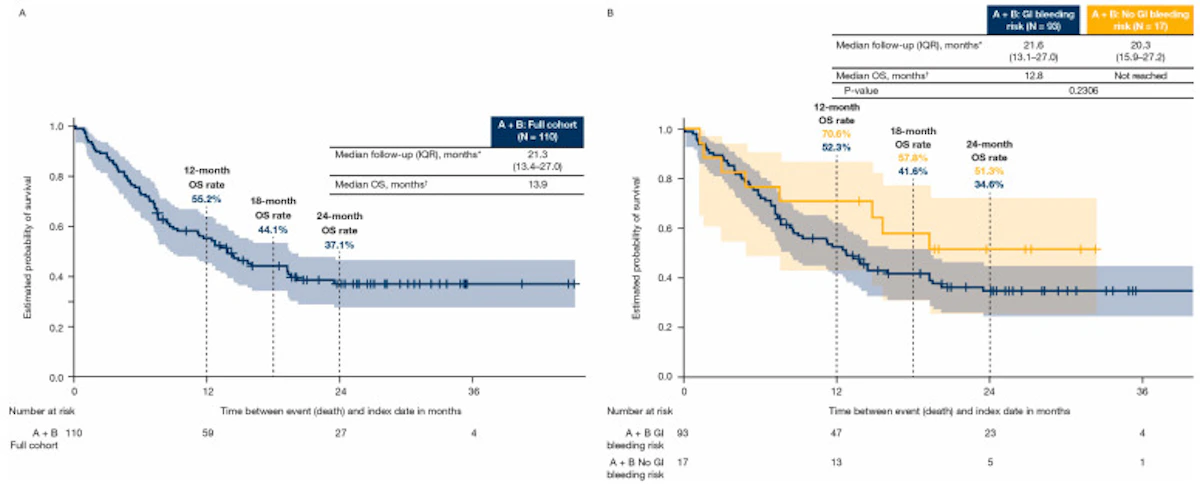
Atezolizumab plus bevacizumab was the most common first-line regimen. Among recipients, 12-month survival was 52.3% with GI bleeding risk and 70.6% without it; at 24 months the rates were 34.6% and 51.3%. Use of atezolizumab plus bevacizumab differed by risk group: 72.7% among patients with risk and 29.3% among patients without it during the study period. For atezolizumab plus bevacizumab, survival in the risk versus no-risk groups was 52.3% versus 70.6% at twelve months, 41.6% versus 57.8% at eighteen months and 34.6% versus 51.3% at twenty-four months.
Limitations & interpretation
The results show why a regimen’s real-world outcomes cannot be interpreted without the liver function and bleeding profile of the patients receiving it. The authors highlight the unmet need for clearer guidance that links treatment choices to patient characteristics often excluded or underrepresented in trials. The differences emphasize the importance of liver function and bleeding history when real-world immunotherapy outcomes are compared with trial populations or across practices. Small retrospective cohort.
Publication type and venue follow the original nference listing. Read the original paper for full methods, analyses, and interpretation. View source listing.