
The workflow captured sentence-level progression with 98.2% accuracy and found the first progression date within 30 days of manual review for 88% of patients.
The research question
Can free-text clinical records be converted into a reliable real-world progression-free survival endpoint?
Overview
A semiautomated workflow combined clinical notes, radiology reports and treatment changes to reconstruct real-world progression-free survival. The workflow reconstructs an endpoint that does not exist as one clean EHR field. By pooling narrative progression, radiology and therapy changes, it produced survival estimates close to manual abstraction and showed why any one document source can be misleading. Progression is often documented in narrative notes and imaging reports rather than a clean structured field, making manual abstraction slow and inconsistent at scale.
Study design & methods
The study configured a general clinical NLP framework to recognize progression language in notes and radiology reports. A change in therapy line could also count as an outcome event when narrative evidence was absent. Progression, treatment-line change, death, loss to follow-up and the study endpoint were combined under explicit event and censoring rules to generate Kaplan–Meier estimates. The cohort contained hormone receptor-positive, HER2-negative metastatic breast-cancer patients starting palbociclib plus letrozole between 2015 and 2021. Clinical notes and radiology reports were processed by an ensemble clinical NLP engine.
Automated and manual survival estimates were closely aligned
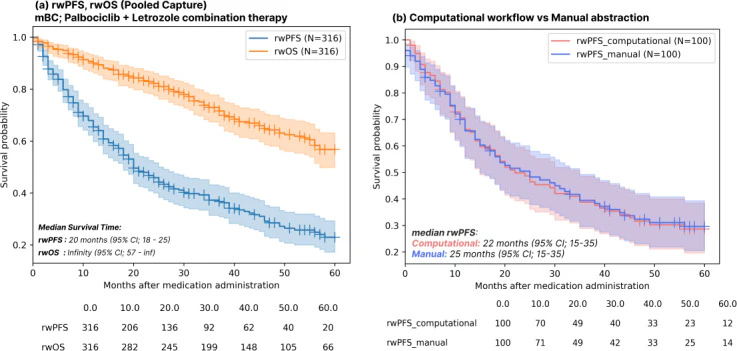
Sentence-level progression capture reached 98.2% accuracy. At the patient level, the first progression date was within plus or minus 30 days of manual abstraction for 88% of patients. External validation of first progression reported 97.4% sensitivity, 78.3% specificity, 90.2% accuracy and F1 92.5% in 61 evaluable patients. Of 199 progressed patients in the main cohort, 152 were identified from unstructured text and 47 from treatment-line changes. The combined estimate produced median rwPFS of 20 months with a 95% confidence interval of 18–25 months.
Limitations & interpretation
Pooling clinical notes and radiology reports produced a more complete estimate than relying on imaging alone, which yielded a longer median rwPFS and likely missed progression documented elsewhere. Sensitivity analyses that removed increasing fractions of events produced overlapping confidence intervals, although uncertainty widened as expected with missingness. The close manual and computational estimates support the workflow as a scalable research instrument, particularly when source documents are pooled and the rules remain visible to reviewers. Semiautomated rules still require expert oversight.
Publication type and venue follow the original nference listing. Read the original paper for full methods, analyses, and interpretation. View source listing.