
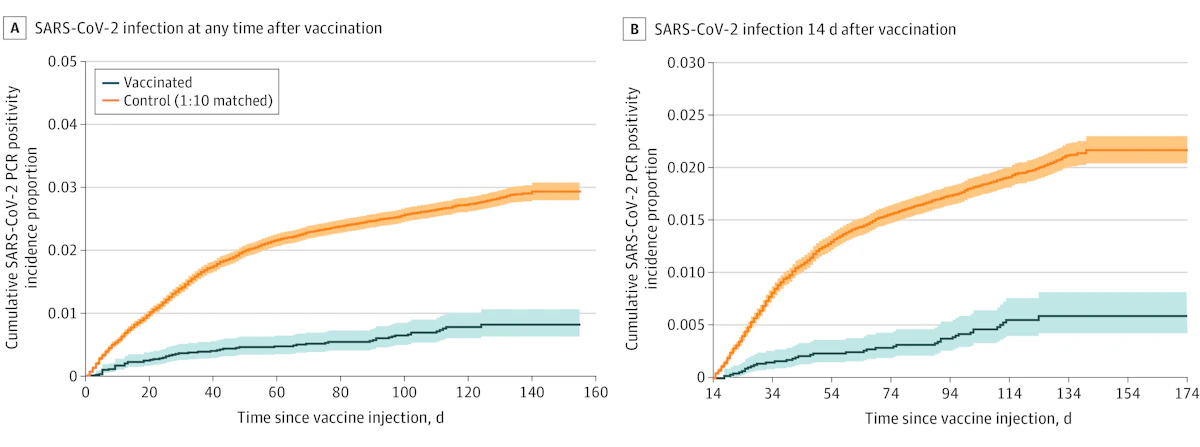
Vaccinated participants had a 3.73-fold lower infection rate than matched unvaccinated participants, corresponding to 73.6% estimated effectiveness.
The research question
Did the single-dose Ad26.COV2.S vaccine prevent SARS-CoV-2 infection in routine clinical practice?
Overview
Across five states, vaccinated adults experienced substantially fewer infections than a closely matched unvaccinated comparison group. The matched EHR analysis found a real-world effectiveness estimate close to the pivotal trial result. Its strength is the large, geographically distributed comparison; its main constraint is that it captures a short, early-vaccine period before later variants and hybrid immunity changed the landscape. The analysis tested whether clinical-trial protection translated to a large, geographically distributed health-system population.
Study design & methods
The final cohorts included 8,889 vaccinated adults and 88,898 unvaccinated controls across Minnesota, Arizona, Florida, Wisconsin and Iowa. Matching accounted for age, sex, race, ethnicity, geography and prior PCR-testing behavior. Eligible adults had at least one PCR test, lived in an area where the vaccine was administered and had no prior positive test. The median follow-up was 111 days in both matched cohorts, and each person's at-risk time ended after infection or death. The final analysis matched 8,889 vaccinated adults to 88,898 unvaccinated controls across Minnesota, Arizona, Florida, Wisconsin and Iowa. Eligibility required prior PCR testing, residence in an area where the vaccine was administered and no documented infection before the index date.
Documented infection was substantially less frequent after vaccination
There were 60 infections among 8,889 vaccinated participants and 2,236 among 88,898 matched controls. The corresponding rates were 0.065 and 0.25 infections per 1,000 person-days. Estimates were stable across alternative starting points: effectiveness was 72.9% from day eight onward and 74.2% from day fifteen onward. The similarity reduces concern that infections occurring immediately after vaccination drove the overall result. Sixty infections occurred among vaccinated participants and 2,236 among controls. Rates were 0.065 and 0.25 per 1,000 person-days, producing an incidence-rate ratio of 0.26 and estimated effectiveness of 73.6%, with a 95% confidence interval of 65.9% to 79.9%.
Limitations & interpretation
The study supported substantial protection from a single dose in a multistate health-system population during a period of changing viral variants. Its large matched control group made the difference in infection rates easier to interpret than a simple before-and-after comparison. The analysis overlapped with the spread of Alpha and Delta, variants absent from the original trials. It supports effectiveness during that window but cannot be carried forward unchanged to later lineages or different immunity landscapes. The analysis supports substantial protection from a single dose during a period that included the emergence of Alpha and Delta. Matching and balanced follow-up reduce several obvious biases, but they cannot remove all behavioral, occupational or clinical differences between vaccinated and unvaccinated people. An observational study cannot exclude unmeasured behavioral differences.
Publication type and venue follow the original nference listing. Read the original paper for full methods, analyses, and interpretation. View source listing.