
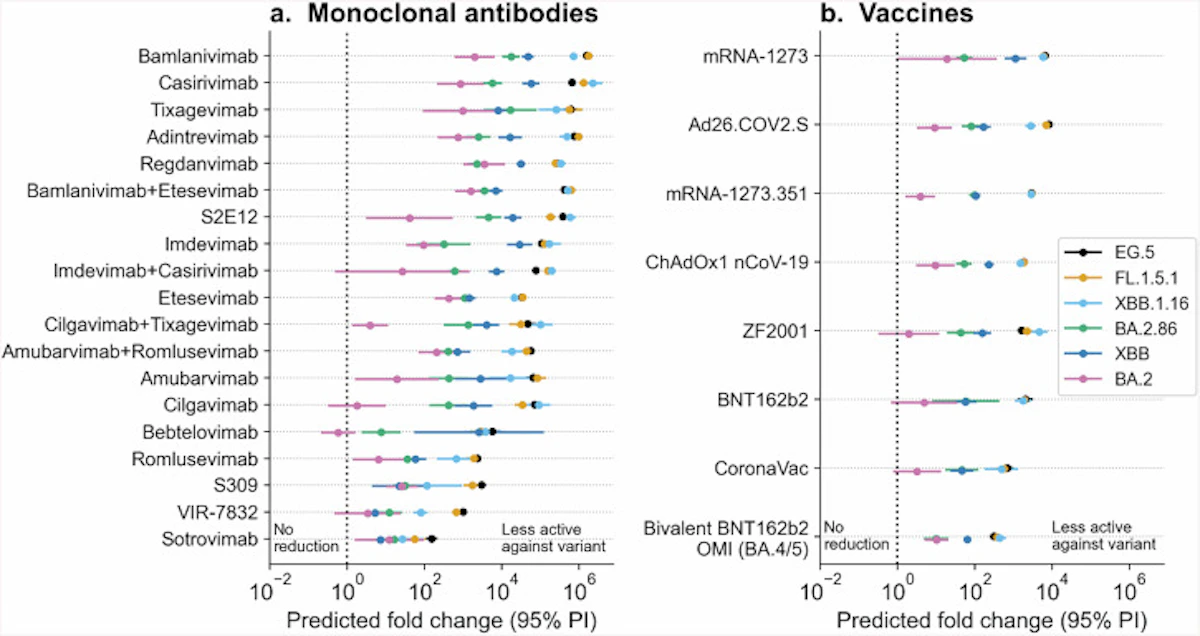
The model accurately predicted fold changes in neutralizing activity for a test set collected after its training window and identified reduced activity against newer XBB descendants.
The research question
Can viral sequence data predict how much neutralizing activity a new variant will escape before conventional testing catches up?
Overview
By learning from viral sequence and neutralization experiments, the model forecast reduced antibody activity against variants that appeared later. The model turns a new spike sequence into an estimated neutralization fold change and an uncertainty value. That pairing is important: it offers a way to rank emerging lineages for laboratory follow-up while showing researchers when the forecast is moving beyond familiar evidence. Laboratory assays remain essential, but they cannot test every new lineage immediately. A calibrated forecast can help prioritize variants for experimental surveillance.
Study design & methods
A variational autoencoder learned a 32-dimensional representation from 67,885 unique spike-protein sequences. A second neural model combined those representations with 7,069 curated neutralization measurements covering 40 antibody or serum categories. The prediction layer represented nineteen monoclonal antibodies, eleven vaccine-serum categories and ten convalescent-plasma categories. Its Bayesian-style loss function returned both an expected fold change and a variance estimate for each prediction. The sequence encoder began with more than 1.2 million downloaded spike sequences. After quality control and deduplication, 67,885 unique sequences trained a variational autoencoder that compressed each 1,273-amino-acid spike into 32 dimensions; held-out reconstructions differed by an average of 2.29 positions.
Predictions held on evidence collected months later
On the later test set, predictions explained 77% of the variance in measured fold change, with a root mean squared error of 0.42. Performance remained similar on 746 therapeutic-sequence pairs not seen during training, where R² was 0.76. Prediction uncertainty correlated with absolute error at ρ = 0.75. Error was not uniform: it was higher for several monoclonal antibodies and lineages with sparse or variable experimental measurements, while vaccine-elicited sera and convalescent plasma were generally predicted more consistently. On the later test set, predictions explained 77% of measured variance with an RMSE of 0.42. Performance on the unseen therapeutic-sequence pairs was similar at R² 0.76. Estimated uncertainty correlated with absolute error at 0.75, providing a useful signal about when predictions were less dependable.
Limitations & interpretation
The useful role is triage: a sequence-based forecast can help researchers decide which emerging variants and antibody combinations should move to the front of the experimental queue. Uncertainty estimates make that prioritization more transparent than a single unqualified score. Roughly three quarters of the held-out therapeutic-sequence pairs were absent from training, although many individual sequences were not completely novel. The authors therefore frame iterative retraining on newly available assays as essential for reliable forecasting over time. The intended use is experimental prioritization. A sequence-based forecast can narrow the large space of lineage and antibody combinations, but it does not make neutralization assays unnecessary and does not directly estimate infection, hospitalization or clinical effectiveness. Predictions complement rather than replace laboratory neutralization assays.
Publication type and venue follow the original nference listing. Read the original paper for full methods, analyses, and interpretation. View source listing.