
Both remained effective, while mRNA-1273 was associated with lower adjusted odds of symptomatic breakthrough infection than BNT162b2.
The research question
How did the two authorized mRNA vaccines compare in routine clinical practice and during Delta predominance?
Overview
Both vaccines strongly reduced symptomatic infection, but their comparative effectiveness diverged as Delta became predominant. Both mRNA vaccines remained strongly protective in the study period, but the head-to-head analysis found a consistent relative advantage for mRNA-1273. The comparison is best read as a time-specific real-world signal shaped by Delta, vaccination timing and the population studied. Head-to-head real-world evidence can reveal differences that individual registration trials were not designed to compare directly.
Study design & methods
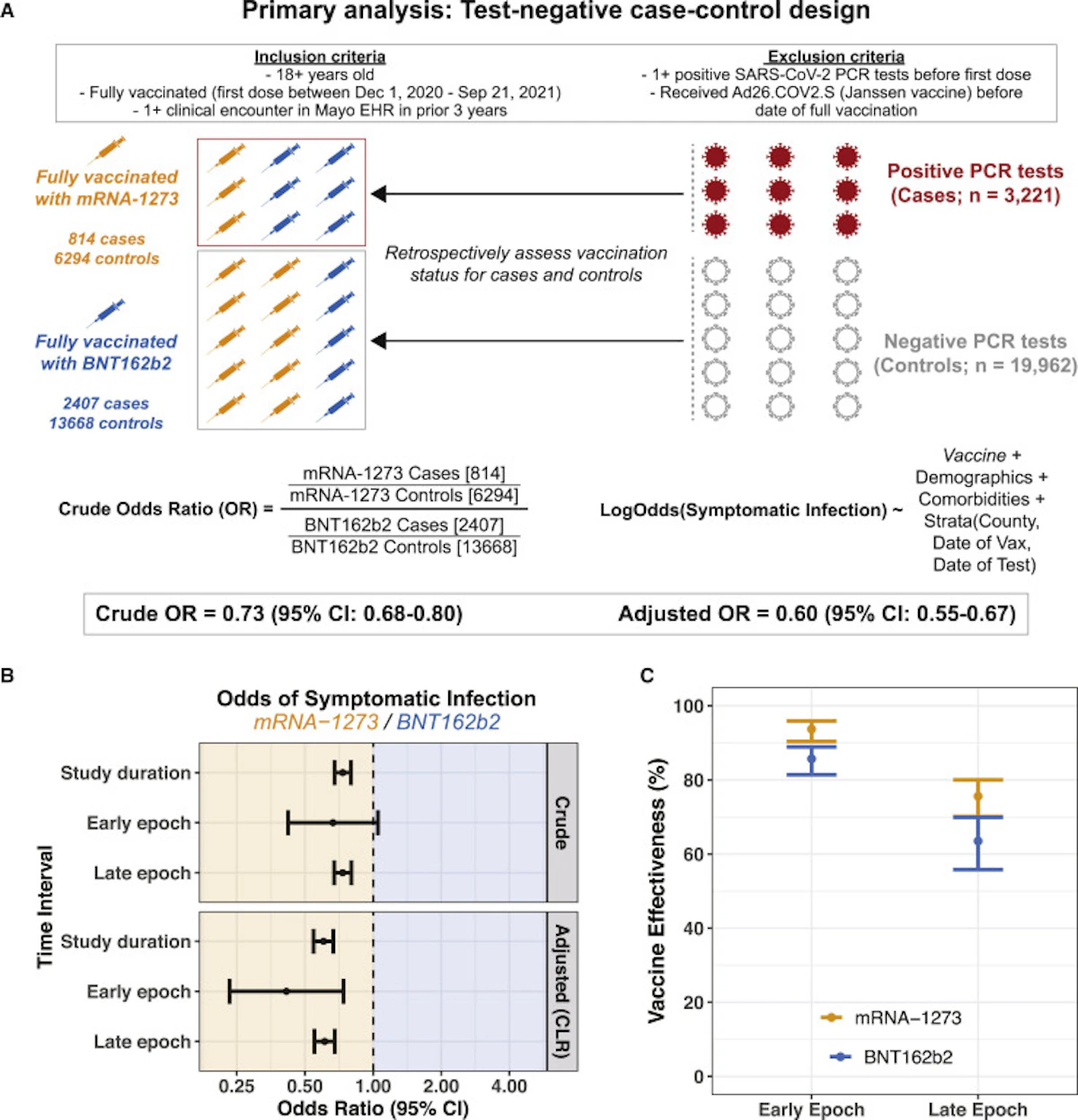
Researchers retrospectively analyzed testing at Mayo Clinic sites from December 2020 through September 2021. A test-negative case-control design compared vaccinated people who tested positive with vaccinated people who tested negative. Analyses were divided into December–May, June and July–September epochs so that calendar time could capture changing exposure conditions and the period when Delta became predominant. Full vaccination and symptomatic testing were defined consistently across products. The retrospective study used Mayo Clinic testing records from December 2020 through September 2021. A test-negative design compared fully vaccinated symptomatic people with a positive SARS-CoV-2 test against similar vaccinated people whose test was negative.
Protection declined in the later period, with a persistent gap
Across the entire study, estimated effectiveness against symptomatic infection was 84.1% for mRNA-1273 and 75.6% for BNT162b2. During July through September, the estimates were 75.6% and 63.5%; during the earlier December-to-May period they were 93.7% and 85.7%. The 95% confidence intervals for overall effectiveness were 81.6%–86.2% for mRNA-1273 and 72.2%–78.7% for BNT162b2. In July–September they were 70.1%–80.0% and 55.8%–69.9%, respectively. Across the complete period, effectiveness was 84.1% for mRNA-1273 and 75.6% for BNT162b2. In the earlier December–May period, estimates were 93.7% and 85.7%; in July–September they declined to 75.6% and 63.5%.
Limitations & interpretation
Both vaccines provided strong protection, and the study's main contribution was to quantify a relative difference that widened during the later period. The result illustrates why effectiveness should be monitored as circulating variants and time since vaccination change. The study's funding and several institutional conflicts were disclosed in the publication. Its accompanying code for assembling populations, calculating incidence rates and fitting the adjusted models was released in the supplemental materials, while patient-level data remained restricted. The study supplies a direct comparative estimate that the original registration trials were not designed to produce. It also demonstrates why vaccine effectiveness needs to be monitored continuously as circulating variants, exposure intensity and time since vaccination change. Observational comparisons can retain residual confounding.
Publication type and venue follow the original nference listing. Read the original paper for full methods, analyses, and interpretation. View source listing.