
Not in this cohort. Although 94.2% had at least one component documented, no patient had all seven available and only 0.6% achieved five or more documented components.
The research question
Can routine EHR documentation support a complete seven-component assessment of clinical remission after severe-asthma biologic initiation?
Overview
Among 707 biologic-treated adults, routine records captured at least one remission component for most patients—but never the complete set needed for comprehensive assessment. The central finding is about measurement feasibility: routine records rarely contained enough information to apply a complete seven-component remission definition. Missing documentation must not be mistaken for failure to achieve remission. A treatment target is only useful when its components are measured consistently. Missing remission data can make a successful or unsuccessful outcome impossible to distinguish from incomplete documentation.
Study design & methods
Eligible adults initiated a respiratory biologic between 2015 and 2022, had baseline asthma and maintained clinical activity through the follow-up year. The final cohort contained 707 patients. The source EHR contained structured and unstructured data for more than seven million patients. NLP models were used to recover asthma diagnoses and biologic use that might be absent from structured fields. The cohort included 707 Mayo Clinic adults who initiated a respiratory biologic from 2015 through 2022 and remained clinically active during the following year. Seven consensus remission components were sought across structured and narrative data.
Documentation fell sharply as more criteria were required
At least one component was documented for 666 patients, or 94.2%, but none had all seven criteria available. Controller and rescue medication use were commonly documented, while asthma-control tests, lung-function stability and missed work or school were sparse. Documentation was available for controller medication use in 90.2%, rescue medication use in 83.2%, systemic corticosteroid use in 55.4% and exacerbations in 33.0%; fewer than 15% had asthma-control or lung-function stability documented. At least one component was documented for 94.2% of patients, but no patient had all seven available. Controller and rescue medication use were common; repeated asthma-control tests, lung-function stability and missed work or school were sparse.
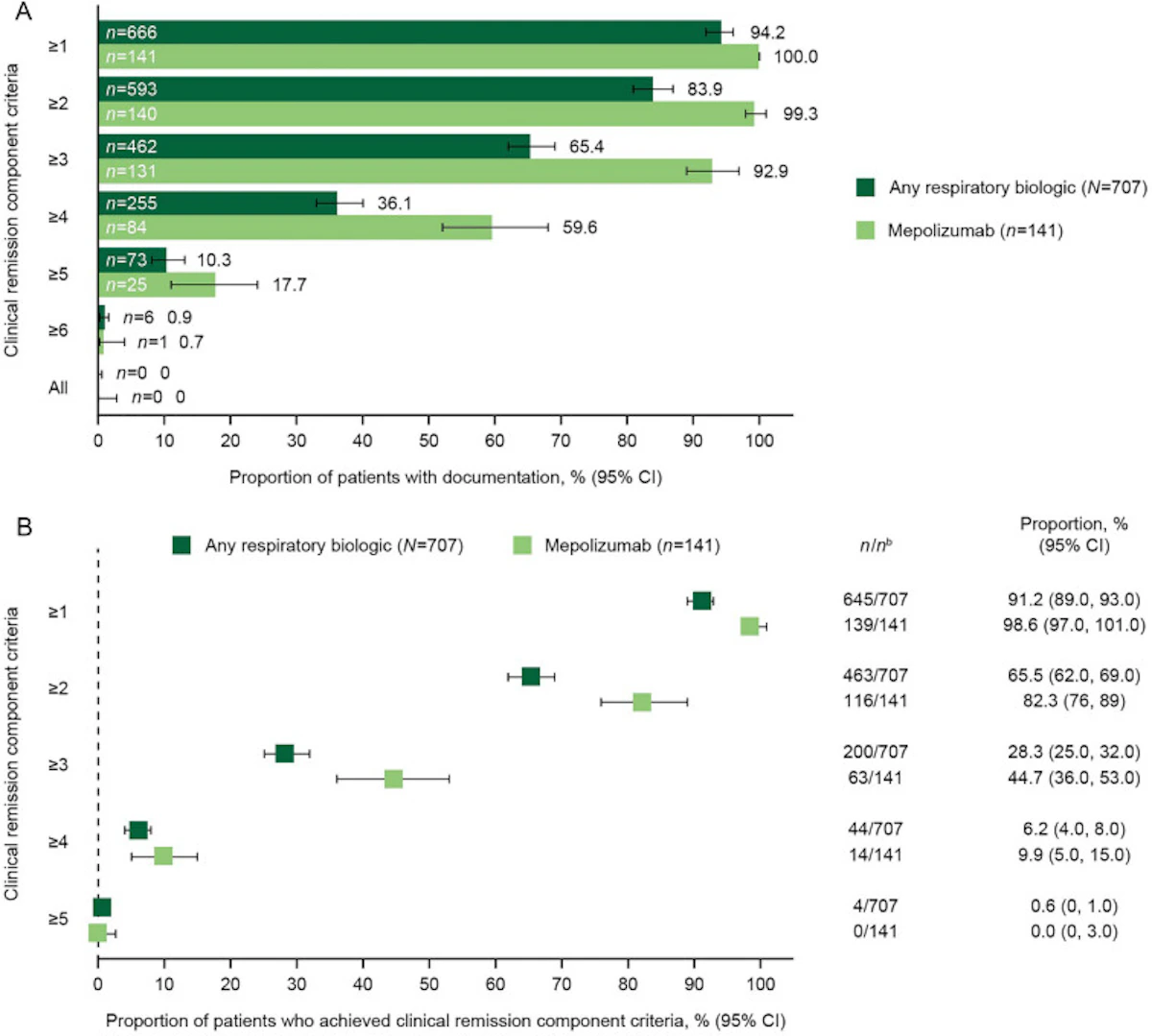
Documentation and achievement of cumulative clinical-remission components after biologic initiation.
Limitations & interpretation
The work does not show that no patients entered remission. It shows that routine documentation could not support the complete consensus definition for any patient in this cohort. The study was funded by GSK and included GSK and nference employees. Its main result concerns feasibility of outcome assessment, not comparative effectiveness between biologics. The study does not establish that complete remission never occurred. It shows that the existing documentation system could not make that determination, which limits both care improvement and comparative outcomes research. Retrospective single-system cohort.
Publication type and venue follow the original nference listing. Read the original paper for full methods, analyses, and interpretation. View source listing.