
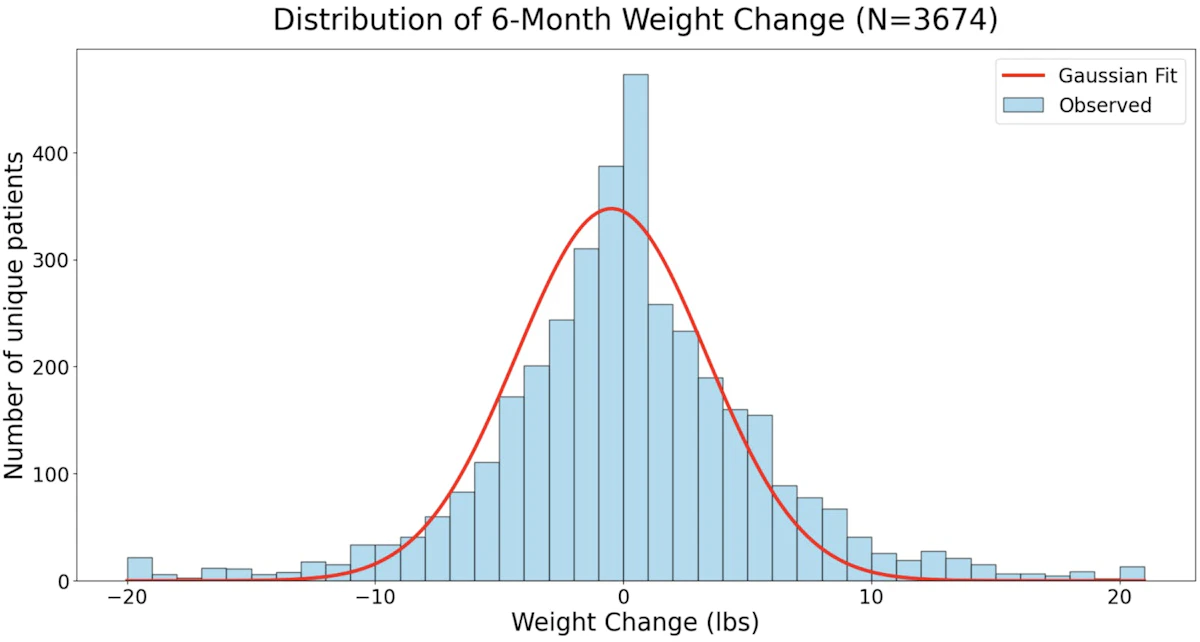
More than two-thirds of both semaglutide and tirzepatide cohorts remained stable or continued losing. The analysis cannot confirm true treatment cessation or exclude prescriptions obtained elsewhere.
The research question
What happened to recorded weight after the last GLP-1 prescription visible in participating health systems?
Overview
An nference EHR analysis found that immediate rebound was not universal—but the last prescription visible to a participating health system does not prove that treatment stopped. The analysis describes heterogeneous weight trajectories after the last GLP-1 prescription visible in participating records. Its key boundary is equally important: a missing local prescription does not prove that treatment stopped. Patients and clinicians need a more nuanced picture of post-prescription trajectories. The result identifies distinct groups for future study without assuming that a missing prescription equals a completed course of therapy.
Study design & methods
Patients had at least three semaglutide or tirzepatide prescriptions and no recorded use of another GLP-1 receptor agonist during the analytic period. Weight change was tracked before and after month zero, the last documented prescription date. Patients were grouped as having at least 2% weight gain over six months or having stable weight/continued loss. This retrospective grouping describes observed trajectories and does not identify their causes. Patients had at least three semaglutide or tirzepatide prescriptions and no recorded use of another GLP-1 therapy during the analytic period. Weight measurements were aligned around month zero, the last documented prescription date.
Stable weight or continued loss was the more common pattern
The six-month distribution contained 3,674 patients and had a mean weight change of 0.29%, with a median of zero. More than two-thirds of both treatment cohorts had less than 2% regain after the last recorded prescription. At a representative site, exercise counseling appeared in 26.2% of patients without regain and 14.7% of those with regain; diet-counseling documentation was similar at 22.3% and 23.5%. Mean six-month weight change was 0.29% and the median was zero. More than two-thirds of both treatment cohorts had less than 2% regain after the last recorded prescription.
Limitations & interpretation
The findings show heterogeneity and challenge the assumption that every patient immediately regains weight. Exercise counseling was more frequently documented in the no-regain group at one site, an association that deserves prospective study. The authors explicitly call for linkage that confirms treatment status, more complete dose and adherence data, and multimodal monitoring of behavior, biology and comorbidities. The observed trajectories challenge a single immediate-rebound narrative, but they do not identify why patients differed. Behavior, dose, adherence, disease state and continued access outside the connected record could all contribute. Not peer reviewed.
Publication type and venue follow the original nference listing. Read the original paper for full methods, analyses, and interpretation. View source listing.