
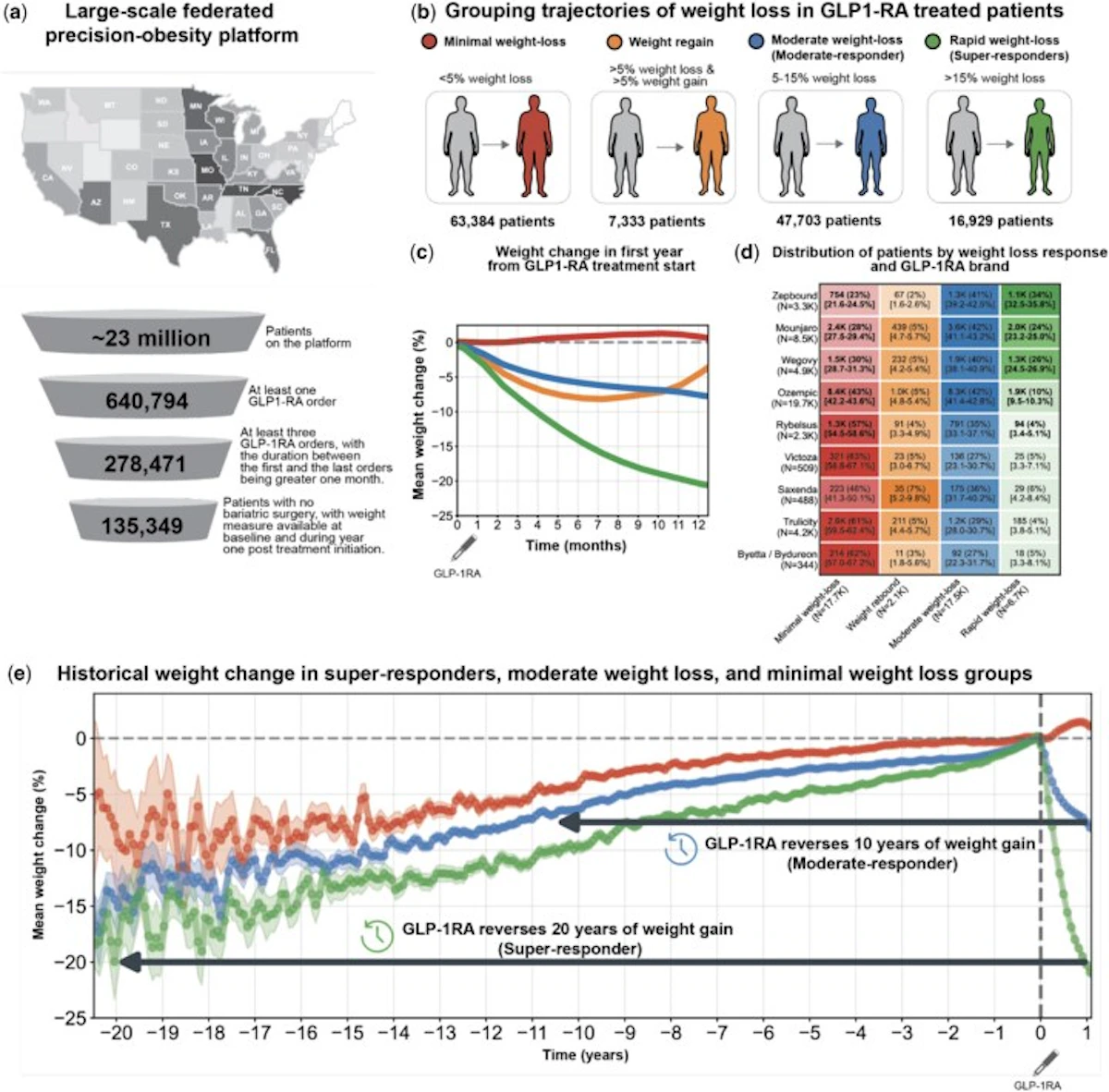
Super-response exceeded 15% weight loss and ranged from 10% with Ozempic to 34% with Zepbound; super responders were younger and more often women in this cohort.
The research question
Which real-world patients become GLP-1 weight-loss super responders, and how do response rates vary by brand?
Overview
A 135,349-patient analysis mapped four real-world weight trajectories and found demographic and clinical differences between super responders and patients with minimal loss. Average weight loss obscures patients who regain, barely respond or lose far more than expected. Distinct trajectories can support more individualized research questions. Average weight loss obscures patients who regain, barely respond or lose far more than expected. Distinct trajectories can support more individualized research questions.
Study design & methods
From approximately 23 million de-identified records, the researchers identified 135,349 patients with sustained GLP-1RA exposure and usable pre- and post-treatment weights. Eligible patients had at least three prescriptions spanning at least one month and no history of bariatric surgery in the analytic definition.
Super-response differed markedly across formulations
The share of super responders was 34% for Zepbound, 26% for Wegovy, 24% for Mounjaro and 10% for Ozempic. Moderate response was more consistent, ranging from 40% to 42%. Women represented about 80% of super responders versus 58–65% of the minimal and moderate groups; the authors treat these as cohort associations rather than biological determinants.
Limitations & interpretation
The work demonstrates that a class-level average cannot describe real-world response heterogeneity and offers phenotypes for prospective study. Prospective research is needed before baseline enrichments can be used for treatment selection. Observational brand comparisons are not randomized.
Publication type and venue follow the original nference listing. Read the original paper for full methods, analyses, and interpretation. View source listing.