
The two transformer models each reached an AUROC of 0.84, exceeding the modest discrimination reported for many conventional risk-factor scores.
The research question
Can routinely collected EHR data identify people at higher risk for Barrett’s esophagus or esophageal adenocarcinoma?
Overview
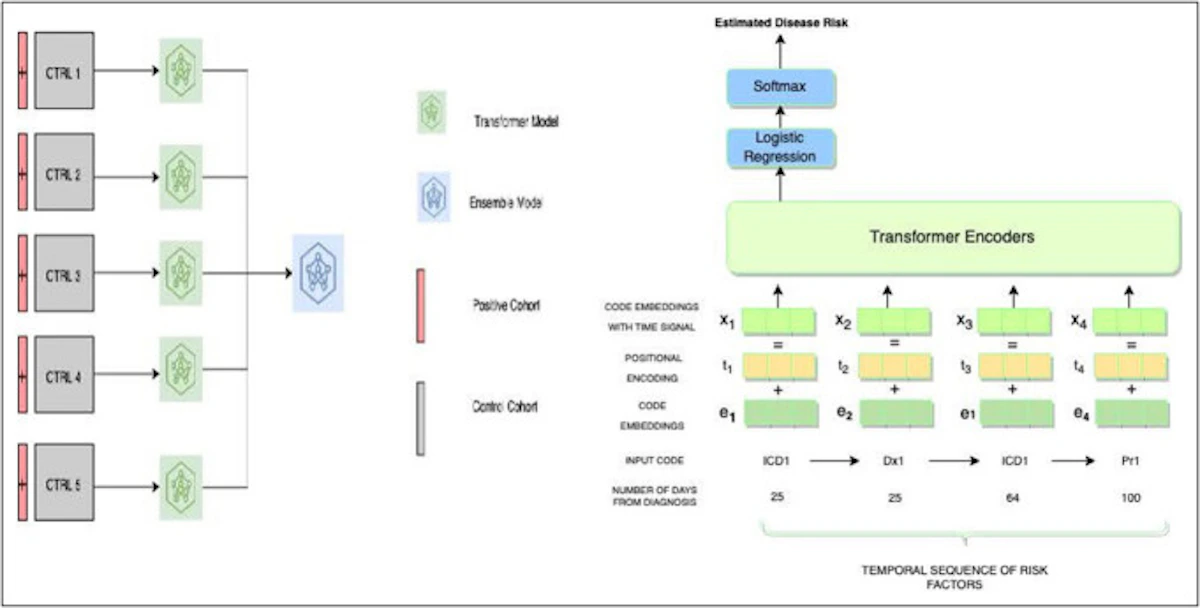
Transformer models combined structured records with information recovered from clinical, endoscopy, laboratory and pathology notes to improve risk prediction. The models expanded beyond a short list of risk factors by learning from longitudinal coded and narrative records. Both reached AUROC 0.84, suggesting a stronger way to prioritize screening while leaving the practical threshold and clinical workflow for future testing. A reliable risk model could help target minimally invasive screening toward patients most likely to benefit, addressing persistent underuse of Barrett’s screening.
Study design & methods
The Clinical Data Analytics Platform contained de-identified records for six million Mayo Clinic patients. Cases were identified with diagnosis codes plus augmented curation of clinical, endoscopy, laboratory and pathology notes. Using multiple randomly selected control groups tested whether performance depended heavily on one particular control sample. The source database covered roughly six million Mayo Clinic patients. Diagnosis codes were supplemented by natural-language processing of clinical, endoscopy, laboratory and pathology notes to improve case identification.
Both models reached the same overall discrimination
The Barrett’s model achieved 76% sensitivity, 76% specificity and AUROC 0.84. The esophageal adenocarcinoma model achieved 84% sensitivity, 70% specificity and AUROC 0.84. The models retained information beyond traditional demographics and reflux-related factors, but individual feature associations should not be interpreted as causal risk factors. The Barrett’s model reached 76% sensitivity and 76% specificity. The cancer model traded somewhat lower specificity, 70%, for higher sensitivity, 84%; overall discrimination was 0.84 for both.
Limitations & interpretation
The models improved discrimination compared with many conventional risk-factor tools and may support more efficient selection for minimally invasive screening. A high AUROC alone does not determine the best screening threshold because the consequences of missed cases and unnecessary procedures must be weighed in practice. A model with better discrimination could make minimally invasive screening more efficient by narrowing the population that needs further evaluation. The real product question is where to set the threshold so missed disease and unnecessary procedures are balanced. Single health-system development environment.
Publication type and venue follow the original nference listing. Read the original paper for full methods, analyses, and interpretation. View source listing.