
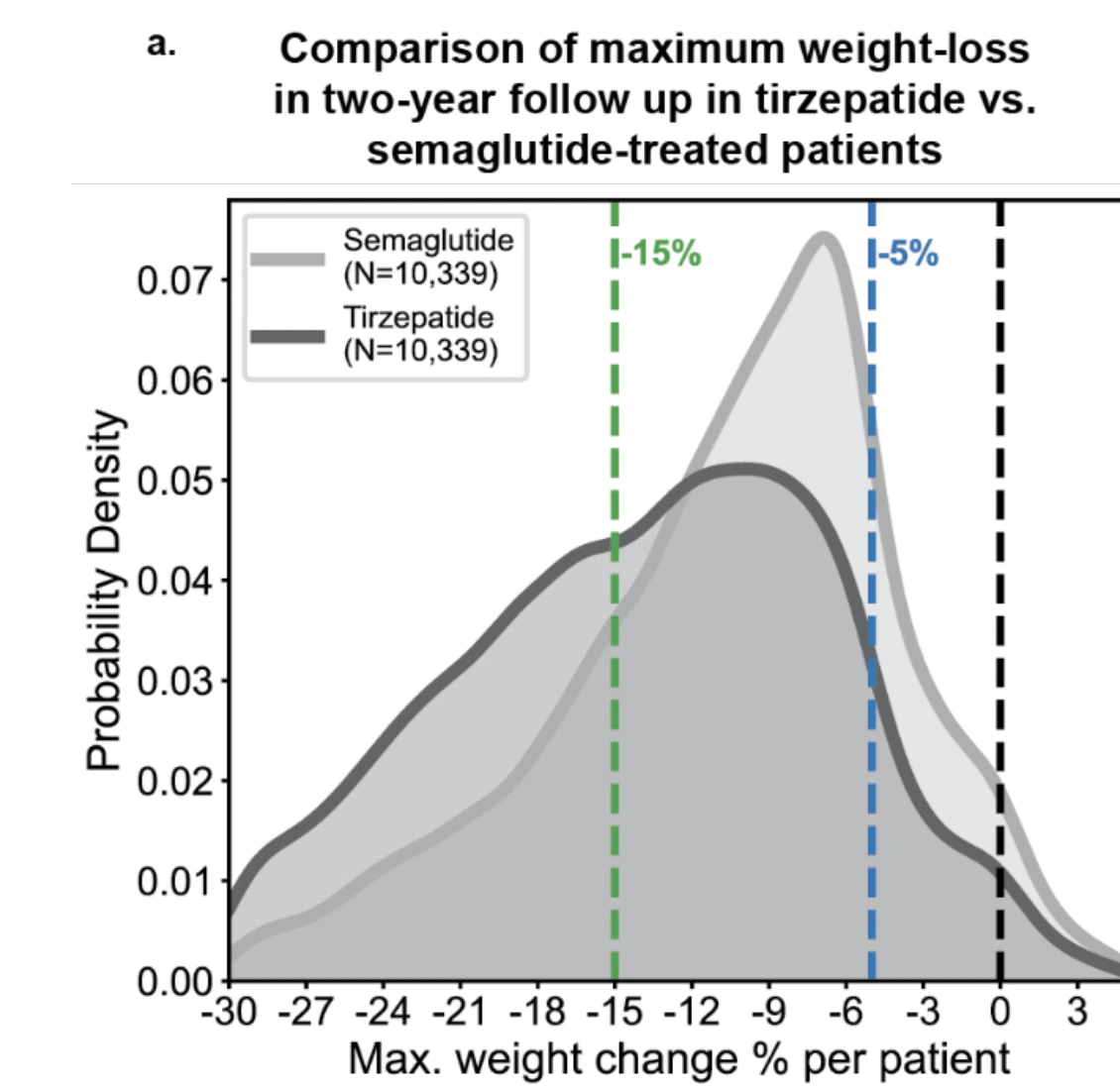
Tirzepatide was associated with a larger mean maximum reduction and almost twice the rate of high response, defined as at least 15% weight loss.
The research question
How do real-world weight-loss trajectories differ between tirzepatide and semaglutide over two years?
Overview
A two-year real-world comparison found greater and faster weight loss with tirzepatide, while also revealing large differences between individual patients. The paper moves beyond a single average by mapping five distinct two-year response patterns. That makes the work useful both as a comparative-effectiveness study and as a starting point for investigating why patients on the same drug can follow very different trajectories. Average weight loss hides meaningful response groups. Showing the full distribution can help researchers design better trials and study why some patients respond far more than others.
Study design & methods
Patients were matched on factors including age, sex, diabetes status, baseline body-mass index, weight, prescription year and available follow-up. The resulting standardized differences were below the study's balance threshold, reducing measured baseline differences between the two treatment groups. A separate analysis curated sixteen commonly reported adverse events from clinical notes and compared treatment groups within response strata. This was designed to avoid confusing tolerability differences with the fact that one group lost more weight. The source population came from nSights, a de-identified longitudinal EHR environment containing more than 23 million patients. The investigators identified 640,794 people with a GLP-1 receptor agonist order, then required repeated prescriptions and sufficient weight history. The initial eligible groups contained 34,143 semaglutide-treated and 16,034 tirzepatide-treated patients.
The difference grew at higher weight-loss thresholds
Mean maximum weight loss was 14.7% with tirzepatide and 10.8% with semaglutide. Ninety percent of tirzepatide-treated patients reached at least 5% loss compared with 82% on semaglutide; at 10% loss the comparison was 68% versus 47%, and at 15% it was 43% versus 22%. Response also varied across demographic groups. Women were more represented among high responders than minimal responders for both treatments, while Black patients were more represented in minimal-response groups; the authors caution that access, persistence, social factors and unmeasured biology could all contribute. The threshold analysis showed progressively wider separation at larger losses. At least 5% loss was reached by 90% versus 82%, at least 10% by 68% versus 47%, at least 15% by 43% versus 22%, at least 20% by 26% versus 12%, and at least 25% by 14% versus 5% for tirzepatide and semaglutide, respectively.
Limitations & interpretation
The results support a larger and faster real-world weight-loss response with tirzepatide, while emphasizing that both drugs produced a broad range of outcomes. That spread matters: a single average cannot explain why one patient changes very little while another loses more than a quarter of baseline weight. Among high responders, recorded nausea, vomiting, constipation, diarrhea, fatigue and headache were less prevalent after tirzepatide than semaglutide. Because the data were observational and note-derived, those safety comparisons remain associations rather than randomized tolerability estimates. The authors interpret the work as evidence that real-world response is heterogeneous and that drug comparisons should preserve that distribution rather than collapse it into one mean. The matched analysis strengthens the comparison, but it cannot account for every difference in dose escalation, persistence, insurance access, lifestyle or concurrent treatment. Observational associations do not establish causality.
Publication type and venue follow the original nference listing. Read the original paper for full methods, analyses, and interpretation. View source listing.